
Benjamin Shanks explores the topic of power and the way it can lead to our ruin or renewal.

With
Jack, Ben, Tristan and Jono
.
So, we're kicking off, as Stephen said, a new series tonight called Roads to Ruin.
It's going for the next three weeks with six parts, so different sermons in the morning and night, which means we're taking a break from the Christ in Scripture project.
And I'm just waiting to hear if there's a little cheer or if there's an awe, but we're gonna, oh good, okay, there you go. We're gonna return to the Christ in Scripture project in three weeks, but we're kicking off Roads to Ruin tonight.
The core verse for this series is Proverbs 14 verse 12. There is a way that appears to be right, but in the end it leads to death.
In this series, we're gonna look at six things, six topics, which are good things in themselves that look right, but if you go down that road, it will lead to ruin, as the proverb says. So, we've kinda got some stage design.
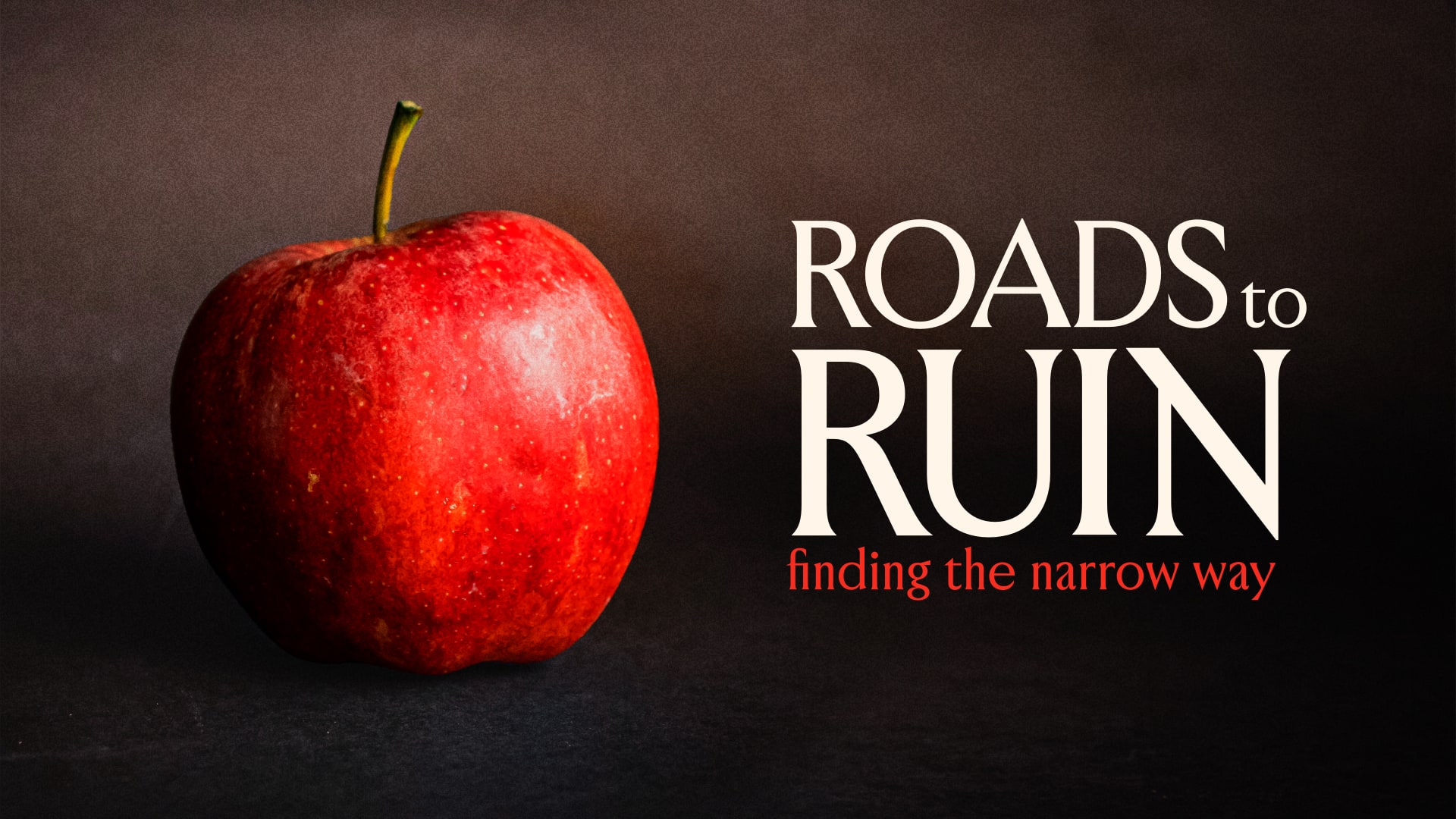
Do you know what this symbolizes? It's not from Lady Macbeth, as Kathleen said. It's the apple of Eden.
The image for this sermon series is the fruit of the tree of the knowledge of good and evil, which when you think about it was a good thing. The fruit was a good thing, but God says don't go down that path.
If you go down that path, it will lead to ruin. So we're looking at six roads to ruin, but not only the bad news, also the good news. We're looking at the way that these six topics can not ruin us but lead to our renewal in the gospel.
So Jesus says in Matthew 7 verse 13, enter through the narrow gate, for wide is the gate and broad is the road that leads to destruction and many enter through it. But small is the gate and narrow the road that leads to life and only a few find it.
That's the invitation for us in this series, that we might find the narrow way of Jesus when it comes to these six topics hurt. That was this morning. Power tonight, next week, anger and doubt and the week after, success and desire.
Tonight we're looking at the ruin of power. How is it that power can ruin us? And how is it that God can use power to renew us as well?
I wonder what comes to mind when you think of power. For me, when I sat down a couple of weeks ago to think about this message, I thought of those immortal words of Uncle Ben. With great power comes...
Perfect. The perfect way to start a sermon on power. Maybe if you're a little bit more academic minded, you might remember these words from Lord Acton.
Power tends to corrupt and absolute power corrupts absolutely. What do you think about when you think about power? Maybe you think about a kind of Darwinian evolution, survival of the fittest, strong, eat the weak type thing.
Friedrich Nietzsche was a German philosopher in the 19th century, and his idea was that all of life is power. People are just fighting invisibly and visibly to get power over each other. Power tends to corrupt and absolute power corrupts absolutely.
I think it's a tricky topic, isn't it? I feel like I drew the short straw in preaching on power. It's gross.
It doesn't feel good to talk about power, but I think that's why we have to talk about it. We have to address it and see what the way of Jesus is when it comes to power. This is the best definition of power that I've come across.
Andy Crouch. Power is the ability to make something of the world. The ability to make something of the world.
Now kind of under the surface of that definition is the kind of implication that we don't all have the same amount of power. Even in this room, this is where power gets weird.
There's 50 people looking this way and one person looking this way and my voice is louder than any other voice in this room. I am more able, weird, to make something of this room right now because of the power of this thing and this thing.
Power is the ability to make something of the world and we don't all have the same amounts of power. So let's map the power spectrum. Powerful to powerless.
High power to low power and talk about each end of the spectrum. So firstly, powerful. What does it mean to be full of power?
To be fully able to make something of the world? Well, power is what we were created for in the beginning. We were created to exercise power under God, to make something of the world.
Genesis 1 verse 26. God said, let us make mankind in our image, in our likeness so that they may rule. And then it says over everything, the fish, the birds, the livestock.
That's power. God made us with power and God saw that it was good. It is good when image bearers reflect God's power into the world.
We've often said, I've often said that what it means to be made in the image of God is a 45 degree mirror. Reflecting God's power into the world and creation's praise back to God.
It's a good thing for us to bear power, but instead of reflecting God's power into the world, we turned the mirror on ourselves.
In Genesis 3, the serpent said, You will not certainly die, for God knows that when you eat from the tree, your eyes will be opened, and you will be like God, knowing good and evil. These are the two lies of sin. You will not certainly die.
In other words, you will not be powerless, and you will be like God. In other words, you will be powerful. So the fruit, this metaphorical apple, the apple of Eden, or whatever the fruit was, it doesn't actually say that it was an apple.
The fruit of the tree of the knowledge of good and evil is power, but the great irony of sin is that what God desires to give freely to his image bearers, we take by force.
We take power from God that he desires to give us, and that's what led to our ruin. The ruin of power, in one word, I think is corruption. When human beings have power, it leads to corruption.
As Lord Acton said, power tends to corrupt, and absolute power corrupts absolutely. Now, we might want to evaluate that later on, but for now, there is truth in that statement. Power tends to corrupt.
When you look at Genesis 3 to 11, what happens after the fall? It's murder, violence, envy, deceit, strife, evil, wickedness. It's power gone wrong.
It's corruption. Look at history. I mean, the dictators of history wielding absolute power, and seemingly to be absolutely corrupt.
Look at even not necessarily people in obvious positions of power, but the corruption of power at a much smaller level. Because of sin, we don't use our power in service of others, but we use it for ourselves at the expense of others.
Power leads to corruption. What I think is insidious about power, and the reason why it's like weird to talk about, is that power tells two lies. The first lie is, I don't have any power.
And the second lie is, the power that I do have, I use well. I don't have power, and the power that I do have, I use well. I was talking to somebody once at church, and they were a lot smaller than me, physically, in stature.
And you don't know who they are, so don't worry about trying to work it out.
And subconsciously, completely like not even thinking about it, I kind of sat on a chair halfway, and I don't have good posture to begin with, but I slumped over even more, so that I was the same eye height as this person, subconsciously.
And we're talking, and it was a really difficult conversation.
The person was kind of attacking me, and quite verbally aggressive, and I'm just sitting down, trying to sort of turn the other cheek, and listening, and trying to find the truth in what they're saying, but it was not fair, and it was hard to keep
listening, until eventually I got to the point where I was gonna start talking. And subconsciously, I stood up, and in standing up, suddenly there was a power difference.
And I tell that story to my shame, because power tells these two lies, that I don't have power, and the power that I do have, I will use well. I didn't realize what power I had, until I had used it poorly.
In trying to get the edge over this person in a difficult situation, I used the power just of being a taller person against this person, as a way of trying to get my way. And I do tell that to my shame, but I think that it's what we humans do.
We use the power that we have to get our way. For men, often, stereotypically, the power of men is physical, it's in a deeper voice and more strength. Often, stereotypically, the power of women is in kind of social emotional ways.
They can use that kind of power. Children have a power. Have you ever seen a screaming child in Kmart?
That child has power. If they make a big enough noise, mom will do whatever I want. There's positional power, that is power that has a name badge.
The president, prime minister, CEO, leader, manager, boss, the person in a position of power, there's personal power.
People who are just charismatic and funny and warm and good looking and loud, and they walk into a room full of strangers and they just have an ability to command action. That's personal power.
There's relational power, people who know a community well. There's power in that. I mentioned these different types of power to try and get you to realize the power that you have.
Because the first lie of power is that you don't have any. And the second lie is that what power you have, you will use for good. Power corrupted leads to ruin, to abuse, even to the more subtle corruption of control.
When we have power, we think that we can control our lives. We can control outcomes, but it leads to ruin. Too much power can lead to the ruin of corruption.
So then, let's go the other end. Let's just get rid of all power. If power is a bad thing that corrupts, let's be powerless.
Let's get rid of all power, which brings us to the other end of the spectrum. What does it mean to not have power, to not be able to make something of the world?
Well, the great irony of sin in Genesis 3 is that in taking the fruit which promised power, we became powerless and naked and afraid. That's the first thing that happens after Adam and Eve ate the fruit.
And in this world, outside of the Garden of Eden, there is a lot of powerlessness. And the first ruin is the lack of power. Power that you don't have.
The Old Testament frequently refers to a particular group of people. And it refers to this group of people as kind of the encapsulation of powerlessness. The widow, the orphan, the refugee and the poor.
Nicholas Volterstof calls them the quartet of the vulnerable. The Old Testament constantly refers to these four or sometimes three of them as a succinct package of those who are powerless in society. Orphans, widows, refugees and the poor.
And it does so because they are in a ruinous situation. They don't have power. They are suffering in poverty and starvation and hopelessness and helplessness.
The lack of power can lead to ruin. But I think there's another more insidious aspect of powerlessness. And that is not the lack of power, but the neglect of power.
Not power you don't have, but power that you don't use. Some of the great injustices of recent history involve an aspect of the neglect of power. So Desmond Tutu was the South African Archbishop who was working against Apartheid in South Africa.
He said this, If you are neutral in situations of injustice, you have chosen the side of the oppressor.
What he means is if you don't say anything in a situation of injustice, you're not on the side of the oppressed, you're on the side of the oppressor. That's the neglect of power.
Similarly, Martin Niemoller, the Lutheran pastor working against Nazi Germany, another significant injustice in recent history. He says this, first, they came for the socialists, and I didn't speak out because I was not a socialist.
Then they came for the trade unionists, and I didn't speak out because I was not a trade unionist. Then they came for the Jews, and I didn't speak out because I was not a Jew. Then they came for me, and there was no one left to speak for me.
This is the neglect of power, not using his power on behalf of others. The third example, Martin Luther King, King Jr., the pastor activist working for civil rights in the United States. The great stumbling block, Martin Luther King Jr.
says, the great stumbling block in our stride toward freedom is the white moderate, who is more devoted to order than to justice, who prefers a negative peace, which is the absence of tension to a positive peace, which is the presence of justice.
All three of these examples, Apartheid in South Africa, Nazism in Germany, and the civil rights movement in the US, involve from three of their key leaders, as in the leaders of the rebellion against it, an aspect of the neglect of power.
And so Andy Crouch, who writes about this kind of neglect of power, he observes what he calls the 1570-15 rule, that in any given population, roughly, it seems like 15% of the population have all the power, and they wield it against the bottom 15
that have no power. But he says the 70% in the middle neglect the power that they have. They're the ones who stand by and keep silent. And so Crouch says the neglect of power is worse than its abuse.
The 70% who do nothing. The one word that I think captures the ruin of powerlessness is resignation. This image of handing over the power that you are supposed to carry.
Yes, to be powerful leads to corruption, but to resign power leads to ruin as well. I feel so challenged by this idea. I'm in Enneagram 9, which is the peacemaker.
I'm like naturally extremely conflict diverse on the five factor psychological model. I'm literally 100% agreeable. I am 100% in the 70 that say nothing.
And I look back at my life, these kind of moments of ruin is a strong word, but these difficult moments where I have failed, I have failed because I was silent and I have neglected to act. That's my vice.
I'm not so much the person that says the thing that he shouldn't have said as the person who didn't say the thing that he should have said. And so I put that before you.
I wonder if you are neglecting to use the power that you have on behalf of those who need it. My concern for us as a society is that AI is going to mean that we lose the power to do the things that we need to be able to do.
I read a study which said that they found a significant negative correlation between frequent AI tool usage and critical thinking abilities. It's kind of like the use it or lose it thing.
If you're a person who constantly, constantly offloads to AI to do your work and thinking for you, you lose the ability to work and think.
I'm scared for my generation, Gen Z, Gen Alpha coming up, that we are just getting shorter and shorter attention spans. We can't concentrate on one thing. We're losing the power to act, neglecting the power that God has given us.
For me, I'm not as worried about what happens when AI turns against us as what AI turns us into, the neglect of power. So where are you neglecting the power that God is calling you to exercise? So then we can step back.
Powerful, powerless, both lead to ruin. The ruin of corruption, the ruin of resignation, is the solution to kind of find the perfect balance. Not too much power, not too little, kind of right in the middle.
Is that kind of the road to the renewal of power? I don't think so. I think that power cannot be held on its own.
We need something else. Something needs to bisect power. That means to cut in half, to hold intention.
And I propose that we bisect power with love. So, this is what that looks like. High love and low love.
High love is other-centred love, self-giving love. And the opposite of love is self-centred lust. My desire, my want, my power.
And so we have a two by two. And we've already seen what it is to be powerful without love, that is corruption. And we've seen what it is to be powerless without love, that's resignation.
What about bottom right? What does it mean to be powerless but with love? In other words, what does it mean to voluntarily give yourself up, to be voluntarily powerless for the sake of love?
Is that not the gospel? Is that not Jesus on the cross? The most powerful person who's ever walked on this earth gave up his power on the cross out of his great love for us.
This bottom right quadrant is Christ crucified.
And so when Paul says in Philippians 2, have the same mindset as Christ Jesus, who being in very nature God, did not consider equality with God something to be used to his own advantage, but rather he made himself nothing by taking the very nature of
a servant, being made in human likeness and being found in appearance as a man. He humbled himself by becoming obedient to death, even death on a cross.
This is powerlessness with love, that even though Jesus had power, he emptied himself of power on the cross. So I suggest that the one word which captures love without power is passion. I don't mean passion is in something that you really love.
I mean the technical term passion, which means to suffer. The word passion comes from the Greek Pasco, to suffer.
What you are willing to suffer for, the passion of the Christ, the suffering of Jesus is powerlessness, but with love, and that's the life that we're called to.
To voluntarily give up the power that we have for the sake of others, out of love, that's the renewal of power. That's not ruin, that's the renewal, the passion, which brings us to the final quadrant. What does it mean to have power with love?
Is that not the resurrection? Is that not the culmination of the gospel? Is that not Christ raised from the dead?
In the kingdom of God, and only in the kingdom of God, passion leads to resurrection. Good Friday leads to Easter Sunday. Death leads to life.
In fact, have you ever played Cluedo before, the board game? You know, on the board, in the corners, the portal, the little stairs, you go from this corner to this corner.
There's a little portal in the bottom corner of death that leads to resurrection life. Jesus, I tell this, this is my favourite image for what Jesus did on the cross.
He went into the cave of death and kicked out the back wall, making a portal into resurrection life. And then he calls us to do the same.
And so that's why Paul says, to finish the passage of Philippians 2, therefore God exalted Christ to the highest place and gave him the name that is above every name, that at the name of Jesus, every knee should bow in heaven and on earth and under
the earth. And every tongue acknowledged that Jesus Christ is Lord to the glory of God the Father. That is absolute power, but with love. Power with love.
And the power of Jesus doesn't lead to resignation or corruption or destruction but to resurrection.
When we follow in the way of Jesus, when we go to that bottom right, the passion corner, it leads to resurrection, the new creation coming to life in us. So then, is it true that power tends to corrupt and absolute power corrupts absolutely?
Is that true? Well, we might say it tends to be truth in it, but it is not absolutely true because of Jesus. Absolute power transfigured by absolute love.
The resurrection power, the power of the passion is power and love together. And that's the way of Jesus. Jesus said, broad is the road that leads to ruin, but narrow is the road that leads to life.
The broad road of power is to use it for myself. Having too much power is corruption, having too little leads to resignation. But the narrow way of Jesus that he invites us to is to transfigure power with love.
That means to voluntarily give your power for the sake of others, to take up your cross and follow Jesus, as he said. The way to eternal life is down and to the right.
And when we go down there, you find the little portal that leads to resurrection life. So what power do you have? You can't keep tricking yourself that you don't have power.
You have power. And how are you using that power? In the way of Jesus, power is given to others out of love.
And when we do that, resurrection comes. So use your power in service of others. That's the narrow way.
And that is beautiful. In theory, it's beautiful when you put it on a screen and it lines up and it's nice. What does that look like?
I want to give you an image from Jesus. John 13. This passage that I'm about to read is what it looks like to go to the bottom right, to live a life of suffering love.
John 13. It was just before the Passover Festival. Jesus knew that the hour had come for him to leave this world and go to the father.
Having loved his own who were in the world, he loved them to the end. The evening meal was in progress and the devil had already prompted Judas, the son of Simon, Ascariot to betray Jesus.
Jesus knew that the father had put all things under his power, and that he had come from God and was returning to God.
So he got up from the meal, he took off his outer clothing, wrapped a towel around his waist, after that he poured water into a basin and began to wash his disciples' feet, drying them with the towel that was wrapped around him.
That's power in service of love. That's service, the spiritual discipline of service, to voluntarily give your power to somebody else. That's what Jesus did.
It says, the one with all power emptied himself of power in service. And so I challenge you, you know how people say, at your service.
Find someone or something, some ministry, some situation and say at your service, willingly, specifically, vocally, or maybe in your head. Tell someone, I am at your service. How can I love you, serve you and bless you?
When you do that, you're giving up your power for the sake of somebody else. And when you do that, it leads to the power of the resurrection. Can we be a church who use power on behalf of those who don't have power, who give power away out of love?
And when we do that, we'll see the kingdom come in and through us. The narrow road to life through power is by giving it away. So let's give our power away.
Let me pray. Lord Jesus, we stand in awe of your example, the one who being in very nature, God did not grasp equality, but gave it away, making yourself nothing.
We thank you that you went to the cross for us, that you descended far deeper than we could ever go. And because of that, we now have forgiveness and eternal life, and we're reconciled to you.
So we thank you Lord for your example, but not only your example, that you set us free from the corruptive power of sin. So God, this is a tricky message. I don't think I've done a very good job.
It's a hard thing to talk about, but Holy Spirit, you go with us from this place. Would you show us the power that we have and teach us how to use it for your glory? Help us to take up our cross in service and love.